Get a Quote from Our Solar Specialists

Category: Solar University

  • Robco Referral and Monitoring App

    The App for your Solar System

    Robco Electric has a free app available for download. The app is used to earn rewards for referrals to monitor your solar system. Download the App, select the sales consultant, and register. Once registered, you can begin sending referrals right away.

    The monitoring experience is built specifically for the system owner. Delivering at-a-glance verification, Monitoring assures you that your Enphase system is performing as expected. Verify system health and performance. View energy production by month, day, or hour. Analyze performance against historical weather data.

    Apple Store
    Google Play Store

    Referrals and Rewards

    Enphase Enlighten Monitoring

  • Why Should You Invest Solar

    Why Should You Invest Solar

    Saving Money, Energy Independence, Environmental Benefits

    People install solar for many reasons. Saving money, energy independence, return on investment, environmental benefits, added value to their home, making an electric car even greener, creating local jobs, and reducing expenses in retirement are all frequently mentioned. Recently, we surveyed our customers, asking them what they like most about going solar. We’ve included some of their answers to that question as we explore why people go solar in more detail.

    Low Power Bills

    House, townhome, or condo – no matter where you live, that power bill shows up EVERY SINGLE MONTH. You don’t have any choice in who sells you power here in NV, and you certainly don’t have any choice in how much you pay for that power! Power rates change over time (mostly upwards) because the cost of fuel changes, the power company builds new transmission lines and new power plants, and their operating expenses change. Of course, they also like to make a profit. What if you could get off that rocket ride of rising rates and fix the cost of power for the next 25 years? With solar, you own the equipment that makes your power.

    The sun shows up every day to give you unlimited free “fuel,” so the price you pay for power never changes! Switching to clean solar power is like going to one of those big warehouse stores, buying something you have to buy anyway in bulk, and getting a huge discount! A correctly priced solar system should cost about 50% of the cost of the same amount of power from the power company over 25 years. Why would you keep paying full price for something you have to buy no matter what, when there is a cheaper and cleaner option?

    Doing the Right Thing for the Environment While You Save Yourself and Society a Bunch of Money

    Fossil fuel use is costly when you add up all the public health costs and resources used to produce it. The IMF estimates that we spent more globally on subsidizing fossil fuel use and extraction ($5.3 TRILLION) than on healthcare for the entire planet in 2015. https://www.imf.org/en/blogs/articles/2015/05/18/act-local-solve-global-the-5-3-trillion-energy-subsidy-problem

    Going solar means your home is no longer contributing to the smog that makes us sick, drilling-induced earthquakes that cause injuries and property damage, oil spills, gas pipeline leaks and explosions, water pollution, excess water use, or injuries or deaths from extracting and using fossil fuels. The EPA calculated that the public health costs from power plant emissions alone are $886.5 billion annually!
    Going solar saves lives, creates a purer environment for our families, and costs less.

    Guaranteed Return on Investment

    Unlike stocks and bonds, which can be volatile, a solar system on your roof is a guaranteed return on investment. Thanks to substantial savings on electricity bills, the average American homeowner pays off their solar panel system in 7 to 8 years and sees an ROI of 20% or more! Is there any other investment you can think of that guarantees even a 10% return?

    Being Independent … from Corporations and Foreign Energy

    When you own the power plant, you make the decisions. No corporation is telling you how you have to make or use power or that you have to pay for them to clean up some environmental mess they made or fire or damage they caused. Instead of enriching someone else, you are putting money back into YOUR pocket. You’re also reducing our dependence on foreign oil. Solar is the ultimate in local energy independence.

    Higher Resale Value on Your Home

    Solar is the ultimate home improvement, unlike a pool that makes it cost more to own than that prospective buyer or a bath remodel that a prospective buyer might not like. Everyone has to buy power, right? Because it makes the house cost less to own, adding solar to your home measurably increases resale value for you and every future owner. No matter what prospective owners believe about the environmental benefits of solar, they will see the value in laughing at the neighbors every time they open those small power bills. https://www.energy.gov/cmei/systems/articles/solar-homes-sell-premium

    Creating Local Jobs

    You can’t install solar from China or Mexico. Investing in solar means investing in our economy and creating jobs for Nevadans like Connie and Krystal. Over 10 MILLION people are employed worldwide in clean energy. Here in NV, with the return of solar, our economy is seeing job growth as solar applications skyrocket. Robco is proud to say our solar division has grown over 300% since solar came back to Nevada.

    Maintenance Free Solution

    Solar has no moving parts to oil or change. Aside from an occasional cleaning, no regular maintenance is needed, and the panels and inverters will last for 25 years or more.

    Controlling Costs into Retirement

    When you go solar, an expense you previously had no control over turns into a fixed cost.

    Ask for a quote today.

  • Do You Need Solar Batteries?

    Do You Need Solar Batteries?

    There is a lot of talk about solar + storage or solar batteries attached to solar systems, but most systems do not come with a battery. There are some excellent reasons for that here in Las Vegas. To help you decide if a battery is a good fit for your project, you first need to understand what a solar storage battery does and how it works.

    What is a solar storage battery good for?

    A battery attached to your solar array is like the battery in your cell phone or laptop. It gets charged by sunlight hitting your panels or power from the grid and will discharge that power in one of two ways.

    BACK-UP POWER: If the power goes out, your home will switch automatically to the solar batteries backup power. Depending on the type of solar and battery system you select, the solar may continue to provide power if the sun is up, or it may be shut off until the battery drains past a certain point.

    LOAD SHIFTING or POWER STORAGE: The solar storage battery will store excess solar production in the battery to use later – during high energy demand times, at night, or during a power outage. Some batteries can also be charged with power from the grid.

    Both sound useful, but let’s dig deeper and see if they make practical and financial sense in Las Vegas and the surrounding areas.

    Batteries for backup power

    Honest solar companies do not include solar batteries by default here in Las Vegas because they are still quite expensive compared to how frequently you use them. What a battery system can power at what any reasonable person would call an “affordable price” does not include central air conditioning, pool pumps, electric water heaters, or charging electric vehicles. These high-load appliances will require three or more battery units to power them—more on this in a minute.

    Most solar PV systems in Las Vegas and surrounding areas are connected to the power grid (grid-tied). The power company’s grid acts like a virtual battery, “storing” excess power production as credits on your power bill. Those credits then pay for the power you need at night, on cloudy days, or in the peak of summer heat. Unlike adding a physical battery which can cost upwards of $20,000 per unit, when all the labor, permit, additional switch gear, and critical loads panel installation are added in, you will not pay any additional cost for this “virtual battery.”

    It would be best if you understood that when the power goes out, a standard grid-tied solar PV system will shut off, too. This is required by the electrical code and is in place for the safety of the utility workers while they restore power. Unexpected power coming from your house would be a hazard to them. As soon as the grid is back up, the system will wake up and start making juice again.

    Here in Las Vegas, with our very stable power grid, we rarely see outages of more than a few minutes, so spending an extra $10,000 – $20,000 to have backup power from a physical battery doesn’t make economic sense for most people.

    Solar Batteries for Load Shifting/Power Storage

    Load shifting means storing power made by your solar array in your battery to use at a different time. Usually, this means energy produced early in the morning is stored in the battery to be used in the late afternoon when some power companies charge a lot more for power. This is called Time of Use pricing.

    NV Energy DOES NOT offer Time of Use pricing as the default. These pricing plans are prevalent in California, Arizona, and Hawaii but are only available by request from NV Energy. So, unless you ask NV Energy specifically to be moved to the Time of Use pricing plans, you have zero financial benefits in load-shifting power. Overton Power District and Valley Electric Association do not offer Time of Use options for our Mesquite and Pahrump customers.

    On the standard residential pricing plan for NV Energy, VEA and OPD, you pay the same price for every kilowatt hour – no matter when you use it. Here in Nevada, load-shifting power from morning hours to late afternoon/early evening has no financial benefit, no matter which utility you buy your energy from.

    If you elect to be on NV Energy’s TOU plan, you can only benefit from load shifting when summer peak pricing is in effect. As of January 1, 2024 that is now 6-9pm every day from June 1st to September 30th. https://www.nvenergy.com/account-services/energy-pricing-plans/time-of-use

    It is important for solar customers to understand that NV Energy puts net metering credits on your account at the kilowatt hour rate that is in effect when the credit is generated, not at the rate in effect when the credit is used. Solar customers generate most of their net metering credits in the spring on the WINTER RATE. Those credits need to be used in the summer evenings on SUMMER PEAK RATE which is 4x as much per kilowatt hour. Your solar system won’t be making power between 6-9pm, so you’ll be pulling power from the grid at that peak price. You need to use 4 net metering credits made at WINTER RATE to equal ONE PEAK RATE kilowatt hour. If you are out of net metering credits, you need to have a very substantial amount of battery storage capacity installed in order to have enough stored power available to keep your ACs running for those three very hot hours every evening all summer long in order to avoid peak pricing. The math just doesn’t pencil out – even on the TOU plan.

    Another way load shifting could help is if your power company has tiered rates. You pay so much per kWh up to 500 kwh on Tier 1, then more for 501-2,000 kilowatt hours on Tier 2, and maybe even more for 2,001 and above. This is common in California, but we don’t have this here (except for the City of Boulder City Power), so load shifting is no financial benefit to avoid tiered rates.

    What can I run on a single solar backup battery?

    The battery most commonly talked about – the Tesla Powerwall – holds 13 kilowatt hours of power and can deliver 5kw in a steady stream. It can surge to 7kw for a few seconds. That’s not a whole lot of juice. Other brands such as Enphase, LG Chem, and Sonnen offer slightly different running and surge outputs, but none surge over 7kw on a single unit. Since most central ACs require a surge current of over 20kw, it is IMPOSSIBLE to power a central HVAC, pool pump, electric water heater, or charge an electric car on a single unit of any of them. (Keep reading to find out more about surge current.)

    So, what can you power on a single solar backup battery?

    You could power some lights, a phone charger, a laptop, an internet modem/router, a TV and your fridge and freezer, a microwave, a fan, or other small appliances. You might even be able to power a window AC unit or a swamp cooler.

    Since these units do not provide nearly enough power to run a central AC (or kind of motor with a high surge current such as a pool pump) during an outage unless you get multiple units, the payback math on any brand of battery doesn’t pencil out in Las Vegas and surrounding areas right now.

    Solar backup batteries in Las Vegas or Henderson only make sense if you have 24/7 medical equipment or some other very critical power need, and you are willing to spend a LOT of money to avoid having that thing go offline for 5 minutes once a year.

    When are solar backup batteries a good idea?

    If you live in the more remote areas and do not have power in your home, an off-grid system with batteries is your answer. The system is not connected to the power grid at all. When the sun is up, the panels power your home and charge the batteries. Once the batteries are full, any extra power is shunted into the ground rod.

    If it’s cloudy or dark, your power will come from the solar batteries. Since you have no connection to the grid to supply backup power, this system is more challenging and quite expensive due to the number of batteries you’ll need to provide overnight power. Off-grid systems use different types of batteries depending on cost.

    Lithium Ion types (Tesla Powerwall, LG Chem, Enphase Encharge, Sonnen): These solar batteries are very similar to those you’d find in your laptop or cell phone … only on a much bigger scale. They use various chemical makeups – primarily based on lithium. They can operate on or off the grid and can be used for either backup power, tier shaving, or nighttime power. Batteries may require a separate inverter.

    Deep Cycle Batteries: This solar battery looks like a boat or car battery. They do not store as much power as the newer lithium-ion chemistry types and must be replaced more frequently.

    Robco can install either type of solar battery.

    If you still want to explore batteries in more depth for your home, you can consult this Enphase storage sizing calculator to determine if it will be cost-effective and how long the selected size would provide backup power.

    Can you run your central AC unit using solar backup batteries?

    Yes, you can run a central air conditioner on a backup solar battery system, but it will cost much more money than you think.

    Understanding surge current.

    When any electric motor starts up (like the one in the compressor of your HVAC), it draws a lot of power for a few seconds to get started. This surge power draw is called the inrush current. Inrush current is like the considerable effort required to start pushing a heavily loaded shopping cart. You strain for a few seconds, then it moves, and the action needed to keep pushing it tapers away. That is how it works with electric motors.

    The big surge current “jump starts” the engine and gets it going. After a few seconds, the power required to keep it going levels off. When you size solar storage batteries, you have to size to meet that inrush current, not just the running power on the motor.

    Electric vehicles also have very high sustained power requirements for charging. Most common EVs require at least 7kw of sustained power to charge. Because that draw exceeds what a single unit of any familiar battery brand can supply, you’d need more than 1 unit to charge the EV.

    Find your inrush current on your HVAC

    To learn about inrush current and get an idea of yours, let’s quickly look at the most significant power user in your home…and the one with the most considerable inrush current, your central AC. You can find the inrush current on your HVAC by checking the data tag. You’ll find the data tag outside the unit, usually near where the hoses are connected. You are looking for two numbers on the label – RMA/RLA and LRA. The RMA/RLA (running motor amps or running load amps) is the number of amps needed to keep the motor running once it gets started. The LRA (locked rotor amps) is the “jump start” current required to get that motor going.

    The battery system has to deliver enough surge to meet the inrush of the AC motor AND power whatever other loads you have connected, such as a fridge/freezer, internet router, lights, small appliances, TV, and so on.

    On the nameplate above, the RMA for this unit is 25.3 Amps or 6,072 watts/6.0 kw. (Operating voltage of 240v x 25.3 amps = 6,072 watts or 6.072 kW).

    The LRA (inrush current) is 146 Amps or 35,040 watts/35.04 kw. It takes over 6x of the running power to start this motor.

    A single unit of the Tesla Powerwall, Enphase Encharge 10, LG Chem, or another backup solar battery generally supplies between 3 and 7kw of surge power. That is not enough to meet the surge on this HVAC system. It’s not enough to meet the surge on ANY HVAC system. Check your label and look for the LRA number to see your surge current.

    If this HVAC were connected to a single unit of any of these batteries, the system would trip and go offline as soon as the compressor started up. We’d have to supply 35.04kw of surge current to operate this HVAC on backup. A solar backup battery that delivers 7kw of the surge would require five batteries to start the AC – never mind any other loads you might want to power.

    Can you reduce the surge current?

    Yes. A qualified electrician can install a soft starter device to reduce the inrush current. With a soft starter, the inrush on this particular HVAC would drop to about 13kw. Better…but it would still require at least two units of most of the standard battery brands to supply enough surge current JUST to run the HVAC! For this setup, a correctly sized backup battery would require three units of all the common battery brands to run this central HVAC system and the essential loads (lights, fridge, cable modem, etc.) on solar battery backup.

    A pool pump. Pumps, electric water heaters, and electric vehicles have similar high inrush currents. You can’t run heavy loads on a single solar backup battery.

    So, the short answer is that backing up your HVAC is in no way cost-effective with current battery technology…even with a soft start installed.

    Learn more about how batteries are sized for both power, energy, inrush current, and hours of autonomy desired by watching this webinar from Enphase.

    If you are still interested in a solar backup battery, we’ll be happy to work with you to find a solution.
  • How Solar Panels Works

    How Solar Panels Works

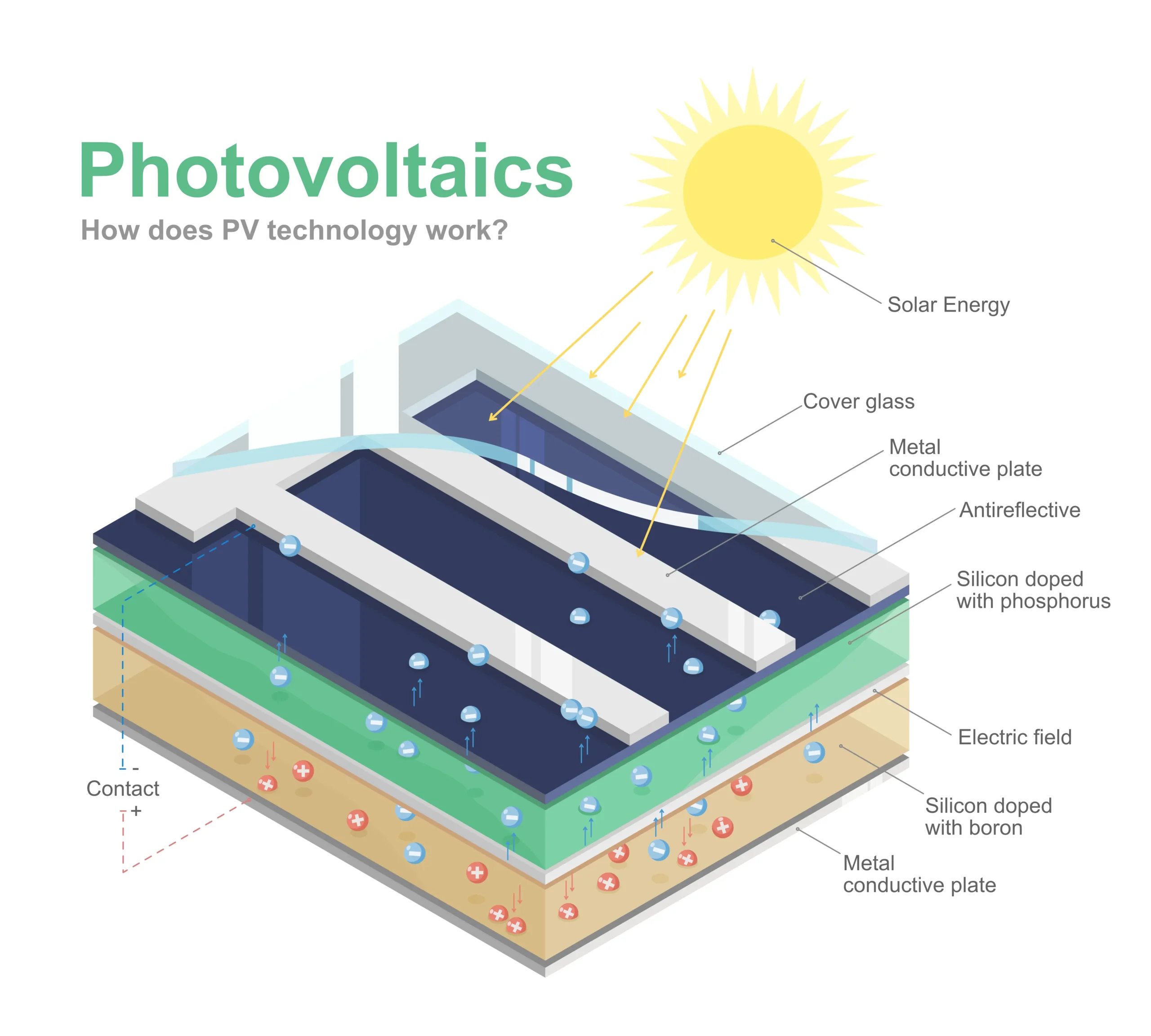
    Solar panels or modules (generally installed on the roof but can also be mounted on the ground or on an overhead canopy, such as a parking structure) are made up of photovoltaic (PV) cells. Current is generated when sunlight hits the cells, converting it into power. The solar panels’ direct current (DC) power is sent to an inverter. The inverter does precisely what the name sounds like – it inverts the current from DC to AC (alternating current) power, which is what your home and everything in it uses. The inverter also monitors your system’s performance and regulates the voltage coming into your home. It’s the “brain” of your solar array. Your inverter will also monitor your system. Our Enphase systems come with lifetime free production and consumption monitoring through the Enphase MyEnlighten application.

    The AC power then travels from the inverter to the electrical panel, often called a breaker box or main panel, and into your home. Anything that uses power, like your dishwasher, your kid’s video game system, or your TV, will draw it from the solar panels first. If solar is unavailable (because it’s dark or cloudy outside), you’ll get your power from the main power grid just like you do now. Everything in your home that runs on power will run exactly as it does now. Your air conditioner can’t tell the difference between running on dirty power and clean kilowatt hours, but your power bill and your lungs sure can! Unlike fossil fuels, solar power doesn’t emit harmful smog, toxic chemicals, or noise that can pollute the air or water. Your home will also gain value, as now you have a power plant on the roof that runs on unlimited free fuel. No more rising utility rates for you! Ask for a quote today.

    How does solar work with the power grid?

    When it’s sunny outside, you could even be sharing that clean power with your neighbors through Net Metering. Net Metering is how the utility pays you to send your clean energy back to their grid. Think of it like rollover minutes on those old cell phone plans before we all got unlimited talk time.
    Net Metering in a Bar Graph: See the orange bars on the graph to the right. That’s solar production. See the blue bars? That’s power consumption. With Net Metering, the extra power you make in the spring, fall, and winter pays for the more considerable power demand in the summer.

    In spring, winter, and fall, we have many clear, sunny days. Most of us are not using our air conditioners, so our power use is way down. During those months, your solar system will usually make more power than your house needs. Whenever that happens, that extra power goes back through your meter, and NV Energy puts a credit on your power bill. That power is then delivered to your nearest neighbor who needs power right that second. Your meter will “spin backward,” and you’ll be banking up credits against your future power bills – just like those old plans would save unused minutes until you needed them. When summer rolls around, and the temperature soars, you’ll need more power than your solar is making. The power company will then use your banked-up credits to pay for it before they bill you. Thanks to Net Metering, if we can replace all your power needs with solar, you could have an average power bill of about $14 a month, year-round

    How does this look on your bill?

    NV Energy offers net metering on a Tiered system. Currently, the state is in Tier 4 at 75% of retail value buyback. At the end of the month, NV Energy will compare what you used (KWHD) with what you sent back (KWHR). What you send back wipes out what you used at 100%.
    If you used more than you sent back, they bill you for the extra (KWHN).

    If you send back more than you used, they will credit you for the excess energy sent back to the grid.

    Any extra (KWHA) is purchased back from you at 75% of the current retail price per kilowatt hour. It’s a credit on your bill (Excess Energy Credit). Like rollover minutes on the old cell plans, the credits sit until you need them. The power company applies them as needed. They never, ever cash these credits out, so it’s important to size your solar to create the amount of power you need and not oversize it. Click here to learn more about sizing your solar system correctly.

    Central Inverters

    Central or String Inverters are old-fashioned technology. With this setup, all solar panels are wired in series (or strings). All the power the system makes feeds from the panels, over your roof as high voltage DC, and down through one inverter to be flipped to AC and then fed into your main electrical panel. The inverter is usually a big box (about 1′ x 2′) and is mounted on your garage wall – hopefully in the shade as they tend to fail in high heat conditions. If you have a lot of panels, you might get stuck with two or more of these clunky boxes on your wall because each inverter can only handle so much wattage. Once it hits the string size limit, you must add another inverter.
    Central inverters are the weakest link in your system. Because all the panels are connected in strings, that means if the inverter has a problem, the whole system stops working, just like those old-fashioned Christmas lights when one bulb burnt out. It also means that if one or more panels are in the shade from a roof vent, a tree, or a cloud, the entire string’s power output is reduced to whatever that lowest-performing panel is doing. Some companies will install a power optimizer on each module to overcome this performance loss and help the system compensate for shade, but that can’t overcome the single point of failure in the system. Power optimizers provide panel-level monitoring, but they are NOT inverters. If the inverter fails, the whole system stops working. In summary, these kinds of systems are much more complex to design. They are subject to a lot of limitations with string sizing. They are far more prone to failure due to the large mechanical cooling fan inside the inverters. Anything that moves can break over time. This is why central inverters typically come with a 12-15 year warranty instead of 25 years. When that fan goes, the unit must be replaced. You will pay to replace a central inverter at least once during the 25-year lifespan of your system. Central inverter systems, even with optimizers, produce less power over the system’s life due to the line loss from the long trip over the roof as DC. Centrals with optimizers are a kludge, not an equivalent to micro inverters.

    MicroInverters

    With a microinverter system, each panel has its own inverter. The DC is converted to AC right at the panel. This means the system is more efficient and produces more power over its lifetime because electricity loses strength the farther it travels before it gets flipped from DC to AC. Lower voltage AC moving across your roof is safer than high voltage DC. It also means that there is no single point of failure because the system is wired in parallel. If one panel or inverter were to fail, the rest of the system would keep making power. Micros also do not have ANY moving parts inside them, so there is no fan to fail. This is why they are warranted for a full 25 years. Robco recommends Enphase microinverters. They offer free lifetime monitoring with the Enlighten website and app and built-in consumption monitoring at no additional charge.

    More power will be produced over the life of your Solar system.

    Having an inverter on every panel means each one is truly independent. If one or two panels are shaded or dirty, the rest of the system couldn’t care less and keeps making power at maximum capacity.

    On a central inverter system, there has to be enough light hitting the panels to create the minimum voltage on the string for the inverter to wake up from sleep. Because microinverters are independent, each panel will wake up from sleep about 30 minutes earlier in the day and go to sleep about 30 minutes later in the evening. Burst mode is the technical term for this. That means you get roughly 1 hour more of production daily from a micro inverter system. Over 25 years, that extra hour can add up.

    More reliable with a longer life span.

    Mircoinverters have an expected lifespan of 25 years and are warranted (parts and labor) for all 25 years. Central inverters – even the ones with optimizers – typically last 12 to 15 years and often fail even before their expected end of life. These failures are widespread if they are not installed in a shaded area. While it is true that it’s pretty simple to replace a central inverter and does not require anyone to get up on the roof, they cost $3,000 or more every time they fail and will take 4-6 hours to replace. If you had to replace it twice in 20 years, you just added $6,000 to the sticker price of your system and added years to the payback time.

    How do we know that microinverters are more reliable?

    Simple. In the last eight years, Robco has installed over 40,000 Enphase microinverters. They have been through many punishing summers, and the failure rate remains less than 1%. You can verify this by checking our reviews; there are no mentions of inverter failures.

    Expanding your system

    You may need more power than your system was sized to deliver at some point. Maybe you put in a swimming pool or buy an electric car. Once your system is up and running, you can add on as needed. Find out more about adding on here.

    If you want to add to a central inverter system, you can only go up to the capacity limit of the inverter (3kw, 6kw, etc.). So if you have a 6kw system with a 6kw inverter and need to add on eight panels because you converted your garage into an office, you’ll need another inverter. Another inverter can cost upwards of $1,500 in addition to the added cost of the panels.

    On the other hand, microinverter systems add a panel and an inverter together. With micros, you can perfectly size your system as your needs grow. No need to spend extra money on equipment you don’t need or pay the power company more than you have to. This design flexibility also means that your install team can easily alter your panel layout in the field if needed.

    Types of panels

    At its most basic, a solar panel is two sheets of silicon solar cells connected by bus bars encased in glass surrounded by an aluminum frame. Just as there are many kinds of cars with different price points and specifications, there are a lot of brands of solar panels with diffeotherifications and prices. The grade of the silicon and the wattage of the panels, as well as how those cells are assembled, all matter when it comes to lifetime power output and reliability.

    Monocrystalline or polycrystalline solar PV panels

    All solar panels are made from silicon crystals. In a polycrystalline panel, each wafers used to make the solar cells is composed of multiple silicon crystals. The process used to make the silicon ingots is a bit like the one used to make particle boards in construction. A single crystal seed is placed in a vat with lots of chunks of silicon, and it’s all melted together. Many crystals grow as they cool. It’s cheaper to make and creates less waste, but the borders where the crystals meet make for a slightly rougher surface which causes electricity to move around less efficiently. This type of panel has a 13-16% efficiency rating. It also has that typical blueish hue due to the composite nature, where light bounces off the rougher surfaces and is reflected back to your eye.

    In a monocrystalline panel, the silicon wafers are sliced from a single pure silicon crystal, giving them a much more uniform surface that converts sunlight into power at higher efficiency (15% to 22%+). Due to the more refined nature of the silicon, monocrystalline panels have a dark black appearance. They also perform better at higher temperatures – a big plus in our desert heat.

    Panel Wattage

    These days, most solar panels are at least 300 watts. That is the maximum rated generating capacity of the panel under perfect test conditions. On your rooftop, though, the output will depend on which way the panels face, how much sun is hitting them, what angle they are tilted at, how high the sun is in the sky, how much shade is present, and how hot it is outside. In practical terms, that means each panel will put out different amounts of power at other times of day and in different seasons. When your solar installer provides an annual power estimate, they consider all these variables. Higher wattage panels will produce more power over their lifetime than lower-wattage panels, even with these variables.

    Degradation

    Silicon crystals break down over time. This is called degradation, and it is a natural quality of the material, so every single panel will lose a little bit of performance as it ages. Environmental factors and stress can increase it to the module structure – like someone walking on your solar panels. Your power output in year 25 will be lower than in year 1. How much will it drop off, and will you notice it? That depends. Manufacturers guarantee that the typical solar panel will produce at least 80% of the day one power at Year 20. Still, manufacturers can reduce degradation in several ways from using more and thinner bus bars to the surface of the cells to the actual composition of the cells themselves. Those technological advances mean that long-term power production from panels is improving. You should look for a panel that offers at least a 90% power output guarantee at year 25, just like our recommended LG NeON 2 panels.

    Bi-Facial

    A bifacial solar panel has a transparent back sheet. The cells used can create power from both sides. It produces electricity using the light that hits the front of the panel and reflected light hitting the back of the panel. When installed at an angle over a light-colored surface, like on a flat roof, in a parking canopy, or on a raised rack on the ground, these types of panels can increase power production. They are typically reserved for commercial installations. However, we may recommend them for flat roof installations

  • Go Solar or Invest the Money

    Go Solar or Invest the Money

    One question we get from customers is:
    “Why should I go solar with this money instead of investing it and making a big return?”

    First, investing is not a need. It is discretionary. It is something you can do, not something you have to do. The phrasing of this question also assumes that the investment will always make money. With investing, there are no guarantees and a possibility of losing money. That loss could be a few percent of your initial or entire investment! Let’s say you decide to invest the money, get lucky, and make a 4% return. That’s great, but you still have a power bill to pay every month.

    Unlike investing, you must buy power. You can’t call NV Energy in July or August and tell them to cut the power because it costs too much! It is not optional or discretionary. You either buy power from NV Energy or get it from the solar panels on your roof by purchasing the system or agreeing to buy the electricity generated by a solar lease or PPA. These are the only choices.

    A purchased solar system can pay for itself in 6 to 9 years using the 30% federal tax credit and cumulative savings on your power bill. Buying solar can reduce your monthly power bill to the basic connection charge, taxes, and fees. Also, according to a recent study by Zillow.com, a return on investment on solar panels when you sell your home could be as much as 4% of the selling price.

    If you choose a third-party owned system, the solar company pays all installation costs and sells you the power the system makes. You will reduce your energy costs by roughly 10% to 20% a year, depending on how their cost per kilowatt hour compares to what NV Energy is charging. That gap may shrink over time as the solar escalator increases the cost you pay the solar company for the electricity the panels make. Click here to learn if it is better to buy solar panels or lease them.

    Remember, you must buy power, and NV Energy’s residential rate has increased from 10.133 cents in July of 2021 to 14.8 cents today, a 46% increase.

    Ask for a quote today.

  • Cool Pools and Power Blues

    Cool Pools and Power Blues

    Las Vegas summers have been filled with cool pools, Marco Polo and Canon Balls for decades. There aren’t many better ways to keep cool and refreshed in a Las Vegas summer than taking a plunge in a swimming pool. Enjoying the sun, with plenty of drinking water and sunscreen, is a ritual here. Evening swimming can’t be beaten either.

    All That Coolness Costs

    Keeping your pool clean and refreshing takes a lot of time and energy (electricity). On average, homes with swimming pools consume 50% more electricity than homes without.

    A variable-speed pump/filter system can add $30–$50 per month to your power bill, while a one-speed pump can add $75–$150 per month. A standard pool pump uses between 1500 and 2500 Watts of energy and typically runs for at least 8 hours daily.

    Here is a list of watts average appliances use.

    • The average home TV uses 50-200 watts.
    • The average home refrigerator uses 350-780 watts.
    • The average home microwave uses 800-1100 watts.
    • The average home dishwasher uses 1200-1800 watts.

    For more information and tips from the Las Vegas Valley Water District, click here.

    What Can Be Done to Offset the Cost of Fun?

    Install Solar Panels. With solar panels and net metering, you can generate electricity and offset your energy bill with credits built up during Fall, Winter, and Spring. An average system can pay for itself in 6-8 years; after that, it’s free electricity.

    To set up a free consultation, please click here.

  • Reconnecting Your Enphase Envoy

    Reconnecting Your Enphase Envoy

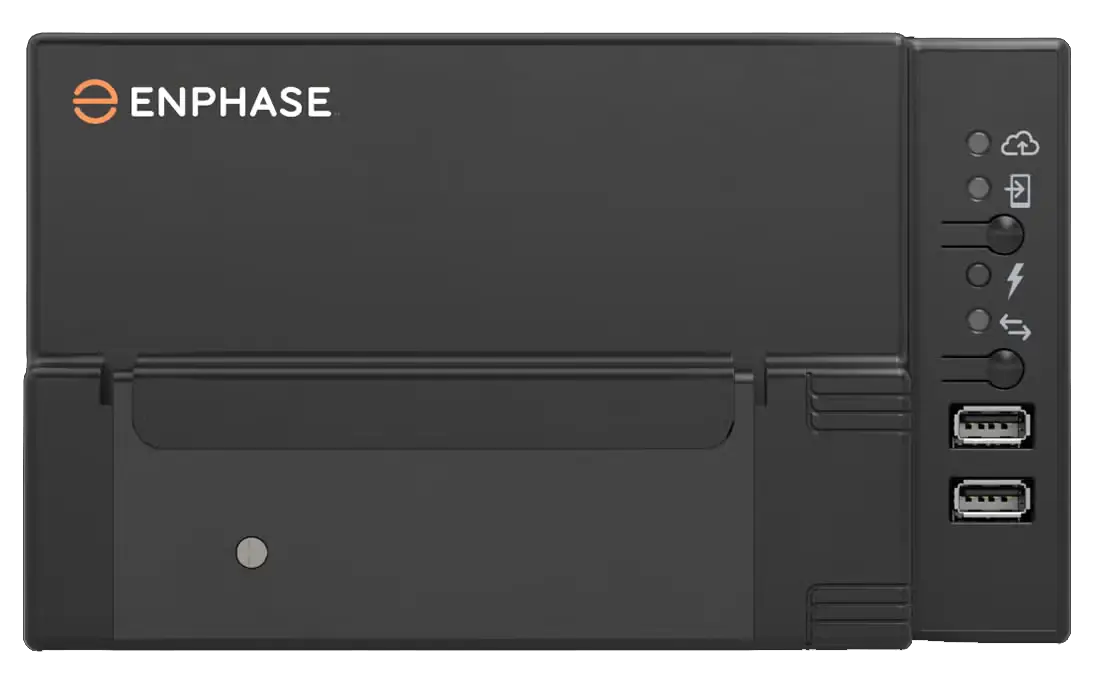
    Using your Wi-Fi and the Enlighten App with reconnecting your Enphase Envoy

    The video below will help you connect your system to the internet to help you monitor and maintain your system.

    Here’s a link to Enphase for more help resetting your connection.

    Once your Envoy reconnects to your wireless network it will begin to download any stored data to the Enphase cloud. Depending on how long your Envoy has been offline this process may take up to a week or more to complete. Once it has, you will be able to review your system monitoring online.

    Please keep in mind that this interruption in data reporting is not an indication that there is anything wrong with your solar system’s generation of energy.

  • Las Vegas Summer Heat and Power Bill

    Las Vegas Summer Heat and Power Bill

    Predicted Las Vegas Summer Temperature Highs

    June: 95° – 106°

    July: 102° – 108°

    August: 100° – 106°

    Insulate your house

    Insulating your house and covering your windows with drapes or shades can keep it cooler. Replace old weather stripping on doors and windows. You can also use window reflectors, such as aluminum-foil-covered cardboard, to reflect heat outside.


    Change incandescent light bulbs to LED

    Switching from incandescent bulbs to LEDs is one of the most effective ways to reduce your power bills. Residential LEDs use at least 75% less energy and last up to 25 times longer than incandescent lighting.

    LEDs emit very little heat, unlike incandescent bulbs, which release 90% of their energy as heat. This simple change can significantly reduce energy consumption and save on power bills.


    Electric fans, swamp coolers, and air conditioners

    Electric fans do not cool the air, so air currents flowing over the body must be cooler than your body temperature to cool you down. It’s important to note that while electric fans may provide some comfort, they are insufficient to prevent heat-related illness when the temperature is in the high 90s.

    Swamp or evaporative coolers can effectively cool the air and maintain a comfortable temperature, making them a safe option for hot climates like Las Vegas. These coolers do not consume as much energy as other options. They reduce the temperature in your home by about 20° and are most efficient when the heat outside is around 80° – 93°.

    Air conditioner compressors work less efficiently at higher heat, so they need more power to cool your home. Change air filters monthly and clean the coils on the outdoor heat exchanger yearly. Dirty filters impede airflow, and dusty coils make it harder for the heat exchanger to work efficiently.


    What else can you do?

    Unfortunately, electricity is used the most in the summer. Almost everything you need to keep your home cool requires electricity. What else can help lower your electricity bill? Install Solar Panels. With solar panels and net metering, you can generate electricity and offset your energy bill with credits built up during Fall, Winter, and Spring. An average system can pay for itself in 6-8 years; after that, it’s free electricity.

    To set up a free consultation, please click here.

  • Enphase’s New 10C Battery Storage System

    Enphase’s New 10C Battery Storage System

    Enphase’s New 10C Battery Storage System

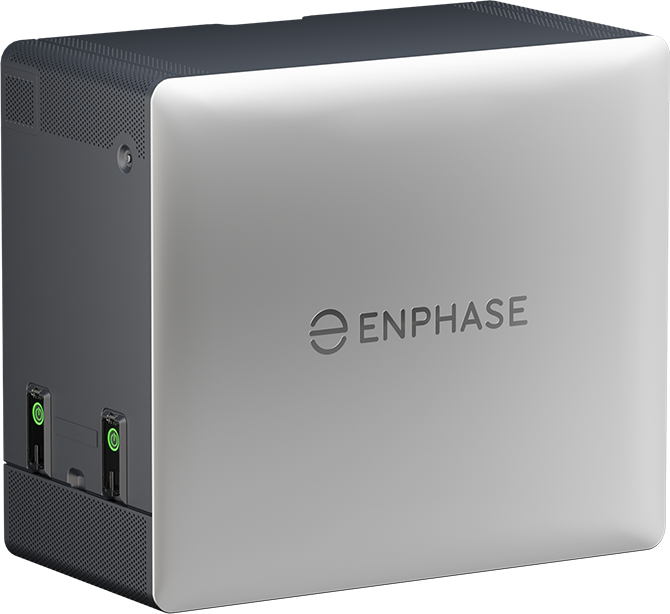
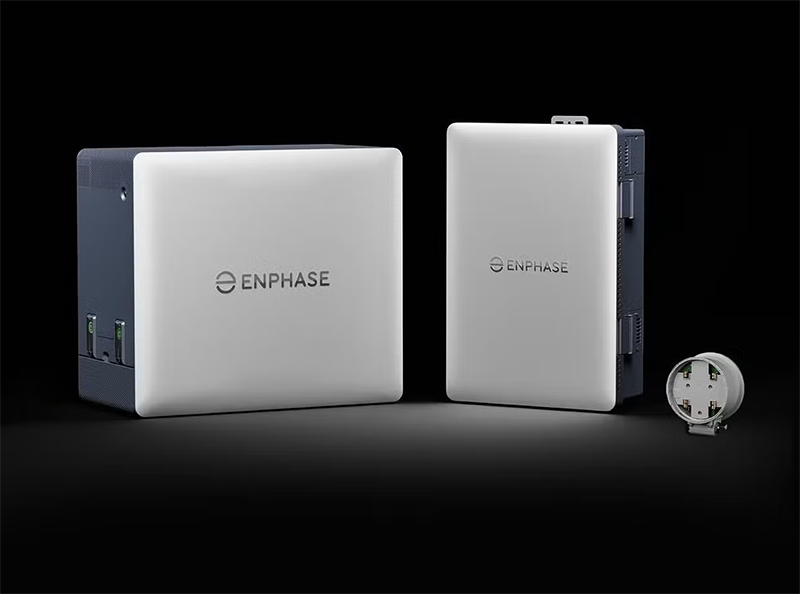
    The IQ Battery 10C is Enphase’s most compact and energy-dense battery, offering 26% greater energy density than its predecessor. With advanced battery management, it minimizes wall space requirements, decreases equipment expenses, and streamlines installation for backup systems. Enphase combines the inverter, battery, and monitoring on a unified platform, providing real-time insights via the Enphase App and establishing the industry’s most adaptable system.

    More power, fewer units.

    All-in-one solar with storage. Effortlessly expand your system as your energy demands increase. Scales from 10 kWh to 80 kWh of battery capacity using a single IQ Combiner 6C. Adding batteries increases both storage and power. Higher battery capacity boosts system efficiency.

    Space-efficient design, more flexibility

    The new space-saving design fits anywhere. The IQ Battery 10C maximizes utility in tight spaces, and the IQ Combiner 6C adds load control and a dedicated EV charger spot. The Enphase battery system occupies less wall space.

    A resilient system

    Compatible with microinverter technology (microinverters convert DC output of each solar panel to AC). If battery energy is fully depleted, the IQ8 Microinverters enable Sunlight Jumpstart, a feature that recharges the battery using solar electricity generated at that moment.

    Faster setup, fewer errors

    Fewer components, simpler wiring, reduced labor, and quicker installation. Pre-installed, pre-wired metering devices eliminate mistakes and compress timelines, while the IQ Combiner 6C’s unified aggregate PV breaker acts as a rapid-shutdown initiator.

    Safe AC power, low risk

    Engineered for optimal safety, it features an AC-coupled architecture and LFP chemistry with integrated rapid shutdown, minimizing hazards for installers, homeowners, and first responders.

    Long-term peace of mind

    Ensures long-term value and system performance. Backed by industry-leading support with a 15-year limited warranty.

    Get your free, no-obligation quote today here.

    Learn more about battery solutions here.

    Discover Enphase product details here.