Reconciling your NV Energy bill with your Enphase monitoring requires matching imported and exported kWh.
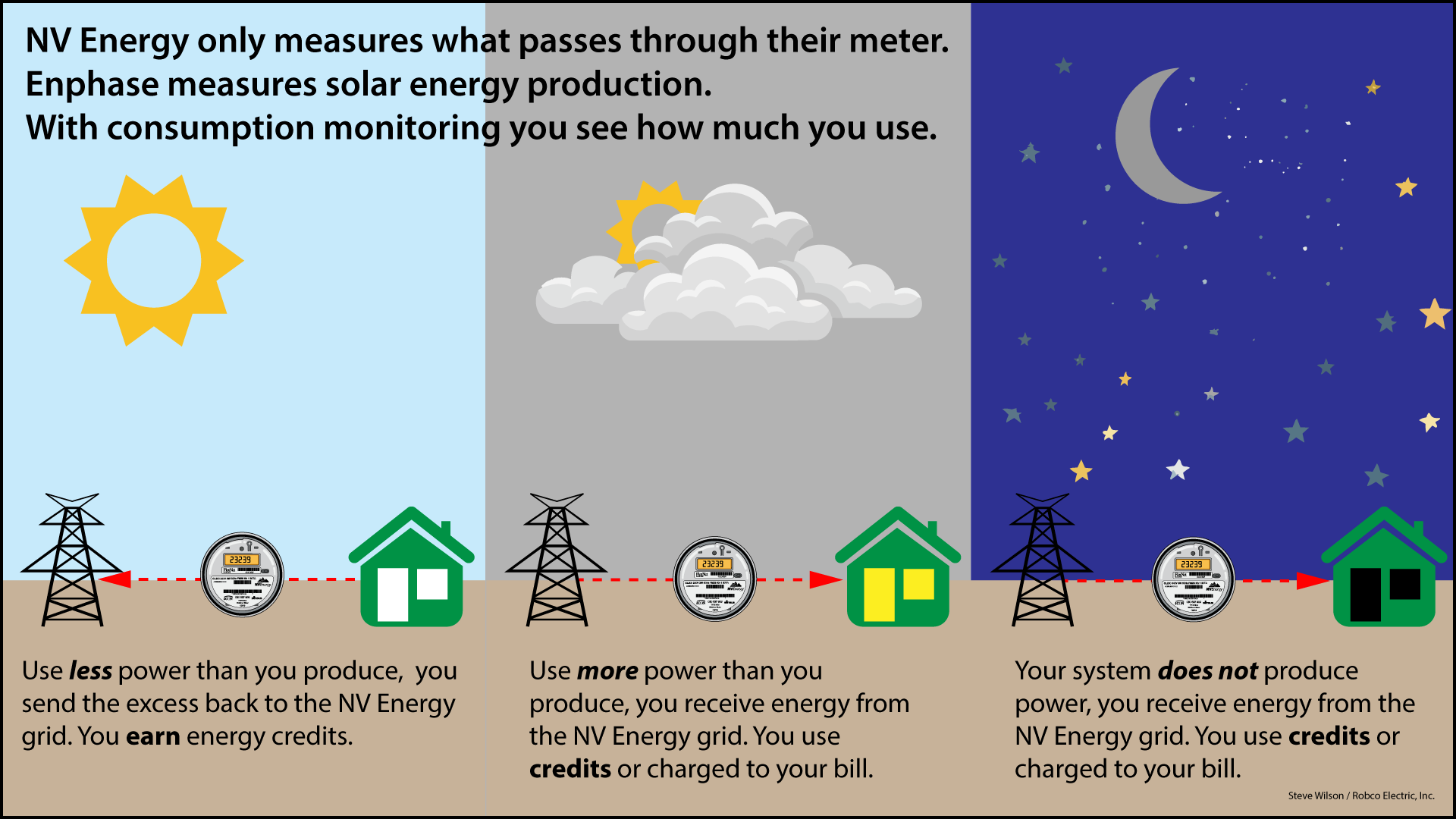
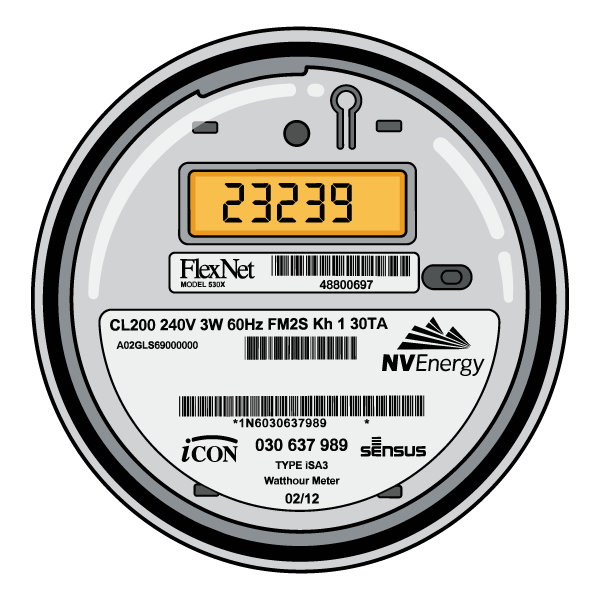
NV Energy can only measure what passes through its meter. They will credit you only for excess solar generation (KWHR) that passes through the meter back to the grid. Similarly, they will only report on energy delivered through their meter to your home. They will charge you for the energy you consume (KWHD) from the grid when your energy needs exceed your solar generation.
Enphase measures total solar energy production and consumption. With Robco installed consumption monitoring, your consumption data will be higher than what the utility bill reports because Enphase monitoring reports all your consumption, whether it came from the grid or your solar array.
Reconciling your NV Energy Bill with the Enphase monitoring.
Open Enphase monitoring.
If Produced is larger than Consumed, then subtract Consumed from Produced. Compare to KWHA on your NV Energy Bill (amount should be within +/-3%).
If Total Consumed is larger than Produced, then subtract Produced from Total Consumed. Compare to KWHN on your NV Energy Bill (amount should be within +/-3%).
Solar systems work with the power company through a billing system called “Net Energy Metering” or NEM. This billing system allows you to receive creditson your power bill for the excess energy your solar system produces throughout the year. Those credits are then automatically applied to your power bill balance when you need them later — just like rollover minutes used to work on cell phone plans before we all got unlimited plans. Just like rollover minutes could not be cashed out, NEM credits can’t be cashed out either. The goal with a solar system is to install the number of panels that will produce as much power as you need in a year, not overproduce. Nobody profits from selling excess solar power to NV Energy. With NV Energy, you receive 75%* of the retail value for each excess kilowatt hour (kWh) you send back to the grid at the end of each billing cycle. Not kWh your system sends back — only the excess kWh at the end of the billing cycle. So, overbuilding your system is not in your financial best interest,
How do solar panels make power for your home?Solar panels or modules are made up of photovoltaic (PV) cells. When sunlight hits the cells, it generates current and converts sunlight into power. Those solar panels’ direct current (DC) power is sent to an inverter. The inverter(s) do precisely what the name sounds like – they invert the current from DC to AC (alternating current) power, which is what your home uses. That inverted power is then sent to your main electric panel, where anything that uses power – like your dishwasher, the air conditioner, your kid’s video game system, or your TV – will draw it from the solar panels first.
If your system is making MORE power than you need, those excess kWh get sent back to NV Energy’s grid through your meter. They are immediately sold to the nearest building that needs power.
If your system is making LESS power than you need, you’ll get that power from the main power grid.
Everything in your home that runs on power will run exactly as it does now. Your air conditioner can’t tell the difference between running on dirty power versus clean kWh, but your power bill and your lungs sure can! Unlike fossil fuels, solar power doesn’t make noise or pollute air or water with coal ash or smog. Your home will also gain value as you now have a power plant on the roof that runs on unlimited free fuel. No more rising utility rates for you! With Net Metering, the extra power you make in the spring, fall, and winter pays for the more considerable power demand in the summer. In the Spring, Winter, and Fall, we have a lot of clear, sunny days. Most of us are not using our air conditioners, so our power use is way down. During those months, your solar system will usually make more power than your house needs. Your meter will “spin backward,” and you’ll be banking up credits against your future power bills — just like a squirrel would be stashing nuts for the winter. When summer rolls around, and the temperature soars, you’ll need more power than your solar is making. NV Energy will then apply your banked NEM credits to pay for the extra power you use before calculating what is owed. Thanks to Net Metering, if we can replace all your power needs with solar, you could have an average power bill of about $19 a month year-round.
What does Net Metering look like on your NV Energy Bill?
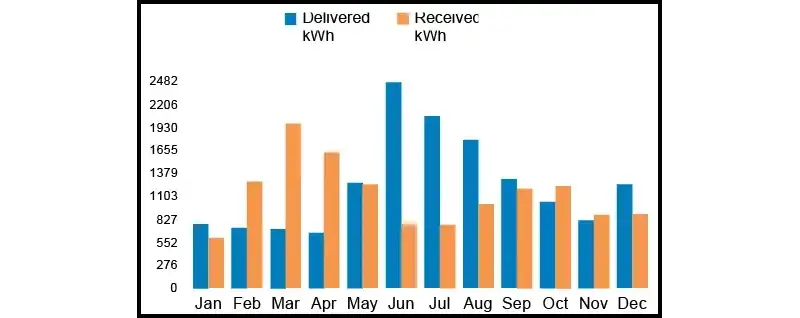
See the orange bars on the graph? That is excess solar production your system made, but you didn’t need it right then, so it was sent back to the NV Energy grid. On your bill, these kWh are labeled kilowatt hours received (KWHR).
See the blue bars? That’s power consumption where your solar wasn’t making as much power as you needed. Maybe because it was dark outside or cloudy, or maybe just because it was hot that day and your AC was running. On your bill, these kWh are labeled kilowatt hours delivered (KWHD).
At the end of every billing cycle, NV Energy settles with you.
The formula is: KWHD minus KWHR = Kilowatt Hours Accumulated (KWHA) or Kilowatt Hours Net (KWHN)
On the bill shown above
1,486 KWHD – 1,648 KWHR = 162 KWHA
The power you send back to the grid (KWHR) wipes out the power you used from the grid (KWHD) on a 1-for-1 basis. You receive 75% of retail for the EXCESS power (KWHA), not for every kWh your solar makes.
You can see how the bank is doing by looking at this section of your bill:
At the beginning of the cycle, you had $142.27 net metering credit in the bank. They added a $18.19 credit for the 162 KWHA this billing cycle. They removed $4.84 in credit to pay for taxes and fees that can be offset with solar. Leaving $155.62 credit in the bank. So how much was the total power bill for the May-June bill with solar on this home?
It was only $18.67! Once your system is on, you will still have to pay the basic connection charge, which is $18, plus any other non-bypassable taxes, fees, or charges. Right now, there are roughly $0.50 to $1 in taxes and fees that cannot be wiped out with Solar, even in a month when you bank up credits like this one. In January of 2027, NV Energy will add a non-bypassable daily demand charge that cannot be wiped out with NEM credits.
This system was installed in 2018, so it is on Tier Net Metering at 95% of retail. Systems installed after 2020 are all on Tier 4 and receive 75% of retail. The difference between 95% credit and 75% credit sounds like a lot, but it is less than $100 a year for most folks. Why is that? Remember, you only receive KWHA at the end of each billing cycle, not for every kilowatt-hour your system makes or every kilowatt-hour you send back to the grid. The average-size system in Las Vegas generates about 2,500 kWh each year.
At 95% of retail on Tier 1: 2500 x .1121 = $280.25 NEM credit On 75% of retail Tier 4= 2500 x .0885 = $221.25 NEM credit A $59 difference.
What if I add on to an older system? Do I lose my NEM Tier?
Yes. The entire system will move to Tier 4 at 75% of retail. That sounds bad, but again, if you are adding onto an older system, that means your system was not producing much (if any) excess power to convert into KWHA. Even in the spring and fall months, you probably had KWHN most of the time instead of KWHA. So, you are losing 95% of almost nothing. The expanded system will finally generate KWHA in those Spring and Fall months, so you’ll see credits on your bills instead of paying most months.
*If the system size is over 25kw, you will receive 100% of retail value on the NMR-B rate.
Why Should You Pick Robco Electric For Solar In Las Vegas?
Unlike some new kids on the block, Robco is not just a Las Vegas solar company or solar reseller that subcontracts your installation to the lowest bidder. We’re a full-service, licensed commercial and residential electrical contractor serving Las Vegas since 1997. Over the last two decades, we’ve done over 1,800 residential and commercial solar installations while also completing millions upon millions of dollars of commercial electrical work. Our Low Voltage Division and Service Electrical Division add to our company’s diversity and financial strength. If you are looking for solar companies in Las Vegas, Robco Electric should be first on your list.
From our earliest days, we put honesty, fairness, and integrity first. Our company has earned the trust of hundreds of repeat clients, such as the Clark County School District and Harry Reid International Airport. We have an unlimited bid license with the State of Nevada Contractor’s Board and have never had a single complaint with the Board. We hire and continually train our solar install crews and Electricians with customer service. Our customer reviews show time and time again that Robco puts YOU first. We are the Number 1 Five Star reviewed solar company on Yelp! We have over 90 positive reviews on Angie’s List. Our many 5-star Google reviews reveal our commitment to customer service, accountability, and honesty. Those reviews have made us one of the best solar panel installers in Las Vegas.
When you choose Robco Electric for your solar panels in Las Vegas, we are committed to being here for you for 25 years. Unlike some of these companies that claim to be the “low price leader” or have only just arrived in Las Vegas, we have the longevity in business, financial strength, and sterling reputation to stand behind our solar panel installations and put your needs first. That reputation for integrity and quality workmanship is our most valuable asset as a business. We’ll do anything necessary to protect it. That means we’ve put aside money to meet warranty obligations and maintain an entire Solar and Electrical Service department to handle any concerns.
Are we the cheapest solar installers in Las Vegas? Will we sell jobs at a loss to match or beat the $2/watt pricing offered by some companies? No, we won’t because getting solar is more than searching for the lowest price. It’s about selecting top-quality equipment for our installations. It’s about charging a fair price for our projects, allowing us to retain our well-trained solar installers and offer concierge-like customer service through our experienced Solar Consultants. It’s about including lifetime FREE production and consumption monitoring and solid metal pigeon proofing at installation that enhances the value of your solar installation for years to come. It’s about sizing your system correctly for your needs and including a Production Guarantee and Power Output warranty that ensures your solar system will deliver the promised energy now and for decades to come. These considerations work together to give you a GREAT solar experience you’ll want to rave about. That’s the kind of experience you can’t offer when racing to the bottom to provide the lowest price.
We’ve ensured that we will be here for many years to come. That means we can offer great technology installed by experienced crews and a no-pressure attitude worth a little more. If you are in the market for solar installation, Robco Electric Solar Las Vegas is here to help.
I hope we can do business together. Ask for a free, no-obligation quote today.
The solar system cost in Las Vegas is influenced by various factors.
While the average solar system size in the area is around 7kw, individual energy consumption habits, appliance usage, and home specifications vary among families.
Customization is key when determining the size of a solar system, as it needs to meet the specific power demands of a household. Achieving the right balance between supply and demand is crucial for optimal performance. An undersized system may result in additional purchases of power from the utility company, leading to unexpectedly high bills. On the other hand, an oversized system can generate more power than needed, resulting in excess buyback credits that do not translate into monetary returns.
Sizing Your System
Sizing Solar Is A Balancing Act: Supply Vs. Demand
Sizing a solar system involves considering the energy usage over the last 12 months or square footage for new constructions. Solar companies typically request recent power bills or square footage information to size the system accurately.
The goal with solar is to match your new system’s power supply to your house’s power demand. You want to hit the perfect balance. Not too big and not too small – just the right size for YOUR needs.
An undersized system will make less power than you need. You’ll buy the remainder from NV Energy at the total price. So, you’ll see a bigger-than-expected power bill after you go solar. You can always add panels later to meet this remaining demand.
An oversized system will produce more power than you need, creating more buyback credits than you can use. Buyback credits are just that, credits. They are never converted into money in your hand. They roll over on your bill until used. So, you will never recover the upfront cost of those extra panels. No one gets rich selling solar to power companies.
What if I Want a Bigger System Now?
If a homeowner desires a more extensive solar system than the utility company approves, a Load Calculation Letter from an Electrical Engineer is necessary to justify the increased demand. Oversizing should be based on provable needs, such as installing a pool or a new air conditioning unit, rather than speculative future additions like an electric car.
What if I Need More Power in a Few Years?
The option to expand the solar system is available for those who may require more power in the future. Additional panels can be added once the system is operational, accommodating changes in energy demand due to factors like introducing a pool, spa, electric car, or new occupants.
Payment options include cash or credit cards, with various financing options also provided for those seeking alternative payment arrangements.
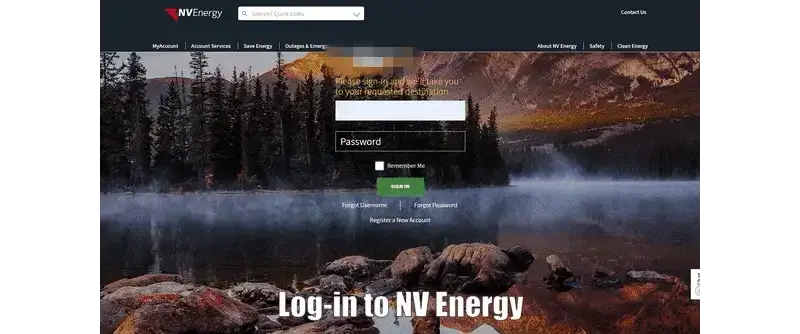
If you do not have an account, you can create one by choosing “Register a New Account.” You’ll need a paper bill or your NV Energy account number. If you do not remember your User ID or Password, you can reset it by clicking “Forgot Your username or password?”
Step #2 – View Statement
On the upper left-hand side of the screen, click the blue words that say VIEW STATEMENT.
Step #3 – Pop Up Window
A pop-up window will open with the PDF of your bill. Save this file and email it to solar@robcoelectriclv.com. If you cannot save the file, capture a screenshot and send us that. Your power bill will look like the image below. If you get an error message that you have pop-ups disabled or you are on some phones that do not allow you to save or read PDFs, go to step 4
Step #4 – Trouble Shooting
If you have trouble viewing the statement or it says your statement is not available, move over to the right-hand side of the screen and click VIEW HISTORY at the bottom of the Billing and Payment History box.
Open the Payment and Billing History tab. Download the PDF by clicking the small box with the down-facing arrow. View the PDF by clicking VIEW STATEMENT. You can save it from there as well. If you are still having trouble, please call your Robco Solar Consultant. We can log into your account and retrieve your bill with your permission. You’ll need to supply us with your Username and Password.
If you have trouble, please call your Robco Solar Consultant. We can log into your account and retrieve your bill with your permission. You’ll need to supply us with your Username and Password.
Don’t have an NV Energy bill yet?
If you do not have a power bill available yet, please log into NV Energy and grab these two screenshots.
NV Energy requires that the Solar Net Metering Application have the info below. We usually pull it off the bill, but we need to use an alternate method for new services.
Once you log in, from the drop-down menu, choose Profile and Preferences: (the exact spelling of your name and address as it appears on the bill and account number)
Sizing Your System
Sizing Solar Is A Balancing Act: Supply Vs. Demand
The goal with solar is to match your new system’s power supply to your house’s power demand. You want to hit the perfect balance. Not too big and not too small – just the right size for YOUR needs.
An undersized system will not make as much power as you need. You’ll buy the remainder from NV Energy at the total price. So, you’ll see a bigger-than-expected power bill after you go solar. You can always add panels later to meet this remaining demand.
An oversized system will produce more power than you need, creating more buyback credits than you can use. Buyback credits are just that, credits. They are never converted into money in your hand. They roll over on your bill until used. So, you will never recover the upfront cost of those extra panels. No one gets rich selling solar to the power company.
Finding the Balance
Your solar system will be sized based on how much power you used in the last 12 months OR by square footage for brand-new construction or a new-to-you house. This is why every solar company you talk to will ask for a copy of your most recent power bill or what your square footage is.
What if I Want a Bigger System Now?
If you want more solar panels than NV Energy will approve, an Electrical Engineer has to justify that demand with a Load Calculation Letter. NV Energy will only allow PROVABLE requests for oversizing. You won’t be allowed to oversize your system because you think you’ll get an electric car in 4 years, but you would be allowed to oversize with a signed contract for a swimming pool or a new AC installed in the garage. Remember, your system should be sized to give you the needed power. Buying extra panels now for a load you’ll maybe add in 2 years is not an intelligent investment.
What if I Need More Power in a Few Years?
Yes, you can add panels later! Once the system is turned on, you may add panels anytime. The most common reasons to count on are getting a new pool or spa, buying an electric car, or having someone recently move into your house.
During a solar installation, your solar contractor will make approximately 200 holes in your roof and install a new breaker in your main panel. All solar contractors in Nevada must warranty the roof against leaks for 10 years after installation.
Tiles are removed and nail holes are sealed
Rafters are located, and mastic is applied to the base of the tile hook
The tile hook is anchored with lag bolts
Mastic is applied to VersaFlash. VersaFlash is pressed in place to cause mastic to seal roof penetrations from lag bolts
VersaFlash is sealed with Mastic and the tile is replaced
Rails are set and cabling is run
Panels are set on rails and clamped in place
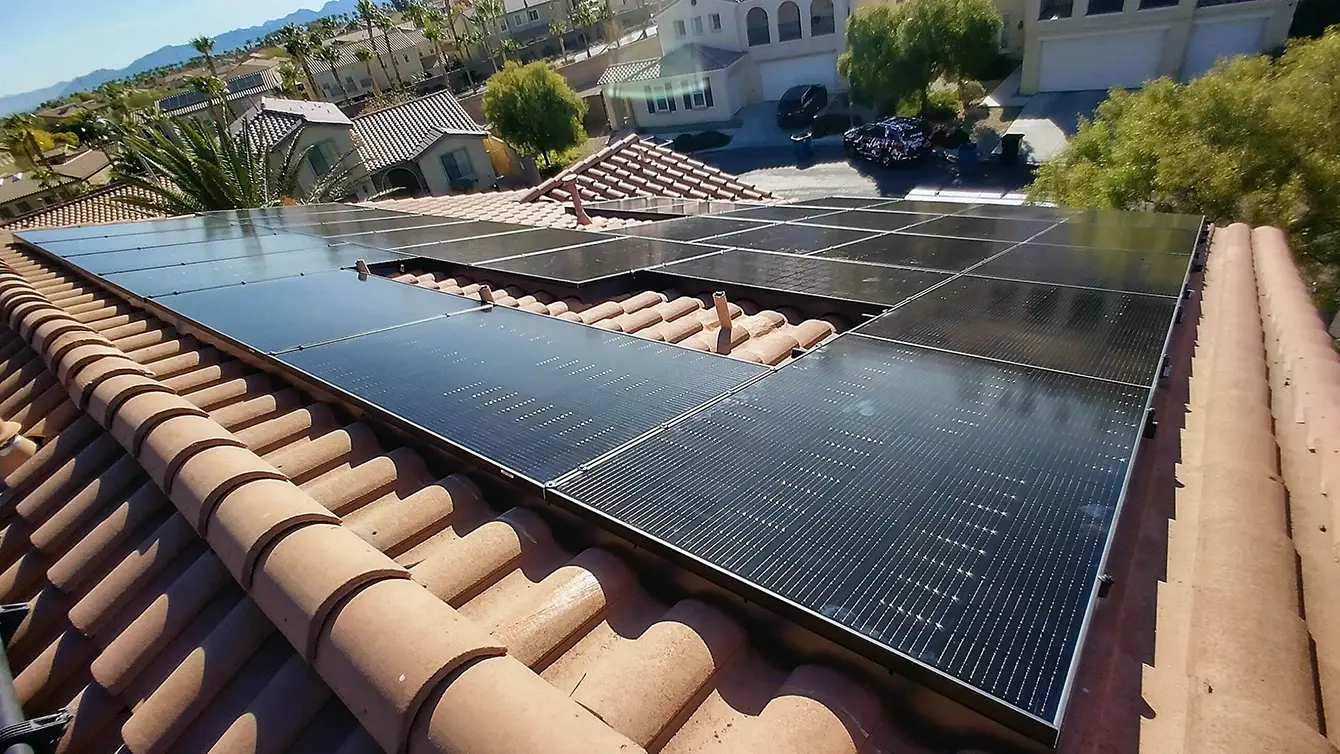
The Finished array before pigeon guard is installed
Your new NV Energy Net Metering bill has a lot of terms and information
Everything you need to know about understanding your NV Energy solar bill and NV Energy Net Metering.
First – The Bar Graph
BLUE – What NV Energy sent to you
ORANGE – What you sent to NV Energy
Second All Those Abbreviations
kWhD, kWhR, kWhA, and kWhN
kWhD (Kilowatt-Hours Delivered)
The amount of energy delivered to your home by NV Energy.
kWhR (Kilowatt-Hours Received)
The amount of energy generated by your renewable system that is sent back to the power grid.
kWhA (Kilowatt-Hours Accumulated)
Calculated as kWhR – kWhD = kWhA
If you send back MORE energy than you use, it will be noted here as credits at 75% of the retail value of energy. These credits never expire and get applied automatically when you need them.
kWhN (Kilowatt-Hours Net)
Calculated as kWhD – kWhR = kWhN
If you send back LESS energy than you use, NV Energy bills for the difference (net power used). kWhA credits are automatically applied if available.
Third Charge Details
You still pay a Basic Service Charge, and all the regulatory taxes and fees applied depending on your service.
Enphase Microinverters offer longer life, a better warranty, more power, and less cost
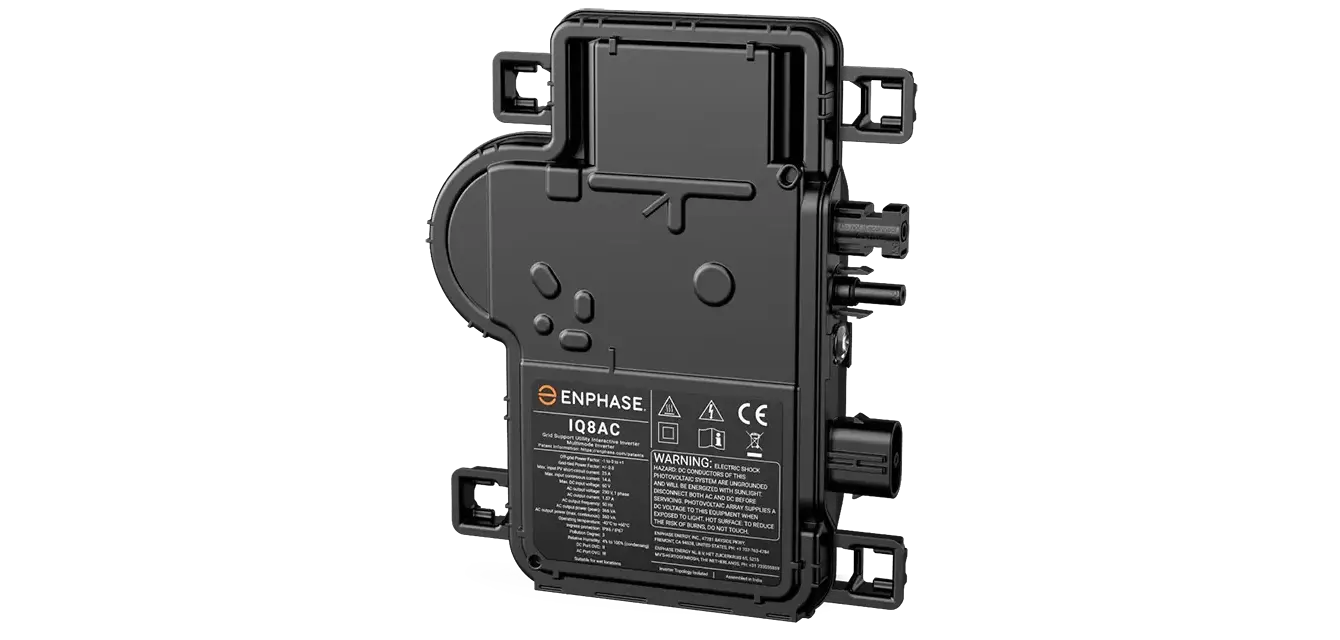
The inverter is the “brain” of your solar system. Solar panels make DC; your house uses AC. The inverter does precisely what the name sounds like; it inverts the current from DC to AC and sends it into your main electrical panel. The inverter also provides the monitoring data for your system to report production to you and your installer. For more information about Enphase Microinverters, click here.
There are two types of inverters used in solar.
Central Inverters
Central or String Inverters are old-fashioned technology. With this setup, all solar panels are wired in series (or strings). All the power the system makes feeds from the boards, over your roof as high voltage DC, and down through one inverter to be flipped to AC before being sent into your main electrical panel. The inverter is usually a big box (about 1′ x 2′) and is mounted on your garage wall – hopefully in the shade as they tend to fail in high heat conditions. If you have a lot of panels, you’ll likely get stuck with two or more of these clunky boxes on your wall because each inverter can only handle so much wattage. Once it hits the string size limit, you must add another inverter.
Central inverters are the weakest link in your system. Because all the panels are connected in strings, that means if the inverter has a problem or there is shade ANYWHERE on the system, the whole system stops working, or the performance of the entire string drops to whatever the least performing panel is putting out. It’s just like those old-fashioned Christmas lights when one bulb burnt out. Each solar string acts like a unit. What happens to one panel on the line happens to ALL of the panels on the series. Some companies will install a power optimizer on each module to overcome this performance loss and help the system compensate for shade, but that can’t overcome the single point of failure in the system. These systems are much more complex to design, are subject to a lot of limitations with string sizing, and are far more prone to failure as these types of inverters only have a 12-15 year lifespan on average and a pretty high failure rate. When they fail, they can take 6 hours and two people to replace, costing $1,500 to $4,000. They also produce less power over the system’s life due to the line loss from the long trip over the roof as DC.
Micro Inverters
Each panel has its inverter right on the back with a microinverter. The DC is converted to AC right at the meeting. This means the system is more efficient and produces more power over its lifetime – up to 3.1% more than the leading DC-optimized string inverter! Why? Because electricity loses strength the farther it travels before it gets flipped from DC to AC. Lower voltage AC moving across your roof is safer than high voltage DC. It also means that there is no single point of failure because the system is wired in parallel. If one panel or inverter were to fail, the rest of the system would keep making power. Robco recommends Enphase micro-inverters. They offer free lifetime monitoring with the MyEnlighten app and built-in consumption monitoring at no additional charge. Moreover, they do very well in our desert heat, with thousands of installs throughout the Las Vegas valley over the last 15 years. Microinverters have excellent reliability and a 25-year lifespan backed by a 25-year parts and labor warranty at no additional charge. If it is necessary to replace a micro inverter, the process takes less than a minute.
With a central inverter system, one shaded or dirty panel can impact the performance of your entire system. When you use advanced microinverters, each panel performs independently.
More power will be produced over the life of your system
Having an inverter on every panel means each one is truly independent. If one or two panels are shaded or dirty, the rest of the system couldn’t care less and keeps making power at maximum capacity. On a central inverter system, there has to be enough light hitting the panels to create the minimum voltage on the string for the inverter to wake up from sleep. Because microinverters are independent, each meeting will wake up from sleep about 30 minutes earlier in the day and go to sleep about 30 minutes later in the evening. (Burst mode is the technical term for this.) That means you get roughly 1 hour more of production daily from a microinverter. Over 25 years, that extra hour can add up.
More reliable with a longer life span
Mirco inverters have an expected lifespan of 25 years and are warranted (parts and labor) for all 25 years. Central inverters – even the ones with optimizers – typically last 12 to 15 years and often fail even before their expected end of life – especially if they are not installed in a shaded area. While it takes about 6 hours to do the work, it is pretty simple to replace the central inverter. That replacement does not require anyone to get up on the roof. However, they cost $3,000 or more every time they fail! If you had to replace it twice in 20 years, you just added $6,000 to the sticker price of your system and added 2-3 years to the payback time. Replacing a microinverter, on the other hand, takes less than 1 minute, and most repairs can be done with software rather than a service call. How do we know that micro inverters are more reliable? Simple. Robco has installed more than 35,000 Enphase microinverters in the last seven years and replaced only about 100.
You’ll see your system’s performance anytime with the easy-to-use Enlighten app on your phone, tablet, or desktop. Production and consumption monitoring are FREE for the life of your system. No monthly subscriptions are required.
Expanding your system
As we’ve learned, central inverters are set up with panels wired in strings. If you want to add to a central inverter system and your inverter is already at capacity, you’ll have to add another inverter and more panels. On the other hand, micro-inverter systems will allow you to add on a single board at a time. You can perfectly size your system as your needs grow. This design flexibility also means that your install team can easily alter your panel layout in the field if needed.
“Microinverters fail in the desert heat.”
This old myth has been debunked repeatedly, yet it still gets repeated. Think about it. Why would a profitable company with a sterling reputation install exclusively a product that failed in the only market they operated in? If this rumor was at all true, wouldn’t you be seeing something like “Robco installed crappy inverters that died in the heat!” over and over again in our online reviews? Microinverters failing in the heat is not mentioned in any consideration for Robco (or any company that installs microinverters in any of the hot places in the world) because this idea that they fail in the heat is just not accurate. We established several thousand microinverters in 2017 and 2018 – the two hottest years recorded in Las Vegas. In the last five years, we have installed over 35,000 microinverters. They are deployed all over Las Vegas, Henderson, Pahrump, and Mesquite. The older systems have been through multiple punishing summers. The hardware failure rate is currently .27%, less than 100 out of 25,000. The internal operating temperature on Enphase microinverters is 185 degrees. Your roof gets hot, but it’s not 185 degrees up there. Extreme heat poses no issues for microinverters.
Solar panels have no moving parts to wear out or need maintenance. On premium panels like the LG ones installed by Robco, unless there is an impact to cause physical damage, they rarely fail once installed. If a part of the system is going to die, it will be the electronics in the inverters. Central inverters, with or without optimizers, are far more heat sensitive than micros.
Pigeons can nest under solar panels and cause damage
Protecting solar panels with Robco’s pigeon guard, also known as critter guard, is designed to look solid and completely flush with solar panels from the ground. We use a solid flashing guard instead of netting or mesh for stronger protection and a cleaner look.
Solar panels produce heat that needs to be dissipated. The guard is installed with an air gap along the edge where it meets the roof tiles and where it is attached to the panel skirting. The gap is enough for rainwater and heat to escape but not for pigeons to get in.
Robco has used this guard design for more than eight years, and several punishing Las Vegas summers have shown no issues.